Four therapies form the foundation of treatment at Ayurdeva, drawn from the Ashtanga Hridayam and administered by trained therapists under physician supervision.
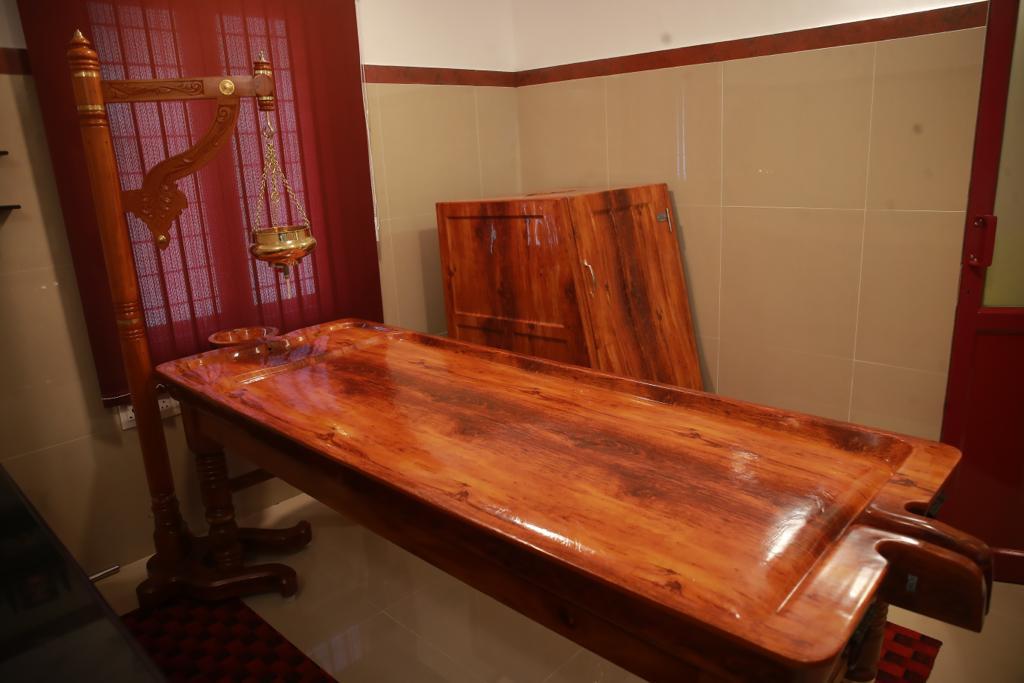
Panchakarma
Panchakarma is the five-part classical cleansing protocol at the centre of Ayurvedic medicine: Vamana (therapeutic emesis), Virechana (purgation), Vasti (medicated enemas), Nasya (nasal administration), and Raktamokshana (bloodletting, used selectively and only where clinically indicated). In practice, most patients undergo a tailored combination of these — not all five — decided by Dr. Parvathy based on your constitution and what you’re being treated for. Because Panchakarma involves genuine physiological cleansing, not just relaxation, it’s administered exclusively as an in-patient programme at our Irinjalakuda retreat, with daily physician oversight, a supporting diet, and a structured recovery period built into the stay. Programmes typically run 7 to 21 days depending on what’s being treated.
Shirodhara
A thin, continuous stream of warm medicated oil is poured across the forehead in a steady, unbroken flow, typically for 30 to 45 minutes per session. The effect is immediate and well-documented: it lowers the physiological markers of stress within a single sitting and, over a course of sessions, has a lasting effect on sleep quality and mental clarity. The oil itself is chosen for your constitution and condition — different bases are used for stress and anxiety versus, say, certain neurological applications. Shirodhara is offered both as a standalone session at our Kochi clinic and as part of longer in-patient programmes at Irinjalakuda for patients whose stress, anxiety, or sleep issues need sustained treatment rather than a single visit.
Kizhi (Herbal)
Kizhi is a category of warm poultice therapy — cloth boluses filled with herbs, medicated rice, or warmed leaves, pressed and massaged rhythmically over the body. Njavara Kizhi (medicated rice cooked in milk) is used mainly for joint pain and arthritis; Podikizhi (dry herbal powders) targets muscular pain and stiffness; Ilakizhi (fresh medicinal leaves) is common for localized inflammation. All variants work on the same principle — sustained, even heat driving the herbal preparation into the tissue while the massage itself loosens what’s stiff. Sessions are available individually at the Kochi clinic for specific problem areas, or as a repeated daily therapy during an in-patient stay for more systemic joint or muscular conditions.
Nasya
Nasya is the administration of herbal oils or powders through the nasal passage — one of the five procedures within classical Panchakarma, and also offered as a standalone therapy. It’s used to clear the head and sinuses, address chronic congestion and headaches, and — because the nasal passage is considered a direct route to the head in Ayurvedic physiology — is also part of protocols for certain neurological and stress-related conditions. A course is usually a short daily series rather than a single session, administered under physician guidance to make sure the right oil and dosage are used for your specific condition.